Share This Speaker

ARTIFICIAL INTELLIGENCE APPLICATIONS IN ORAL MEDICINE
Introduction: Despite the growing interest in the development of Artificial Intelligence (AI) in healthcare in recent years, and the many papers exploring its role in Dentistry, the role of AI in Oral Medicine especially is still unclear.
Objection: This presentation aims to synthesise, analyse and evaluate the existing state of evidence related to the applications, benefits, challenges and future expectations of AI in the context of Oral Medicine.
Material & Methods: The existing research presents our data from the use of an AI application in Oral Medicine that encompasses critical areas for the diagnosis of lesions in the oral mucosa, including oral cancer, oral potentially malignant disorders (OPMDs), skin diseases with oral manifestations such as lichen planus.
Resutls: Our AI application, has proved remarkable potential in terms of accuracy, sensitivity and specificity. Nevertheless the clinicians must be aware that for an AI application, to be accurate, it requires a huge database of high-quality data to interpret information precisely. In addition, if an AI model was used on clinical images, the quality of the image may vary greatly depending on many factors, like camera type and lighting, which may affect the interpretation leading to misdiagnosis.
Conclusions: In conclusion even though current evidence has proven AI to be effective and efficient, it is still considered to be at its infancy stage, and we can expect to see its influence growing in the upcoming years in various fields of dentistry, and especially Oral Medicine, resulting in effective management for patients.
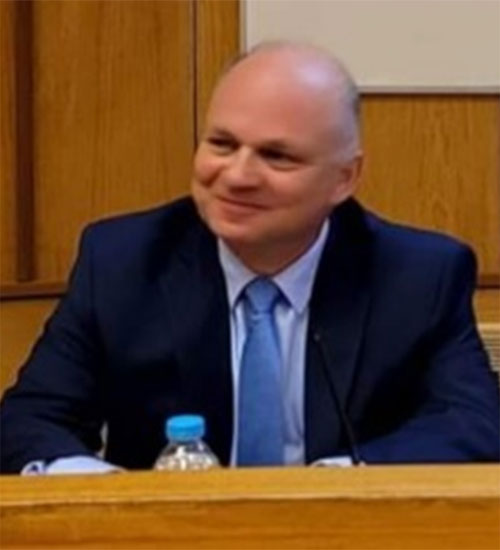
DR Athanasios K. Poulopoulos (DDS, MSc, PhD)
Professor and Director of the Dept of Oral Medicine and Oral Pathology
Dental School of Thessaloniki
Aristotle of University of Thessaloniki Greece.
Professor Athanasios Poulopoulos served as the Dean of School of Dentistry Aristotle University of Thessaloniki, Greece for five consecutive years and currently serves as the head of the Dept of Oral Medicine & Oral Pathology, Dental School of Thessaloniki director of the Postgraduate Program of Oral Medicine & Oral Pathology, and director of the Oral Maxillofacial Pathology, Surgery and Radiology Section. Recently (October 2025) he was elected president for the European Association of Oral Medicine.
Furthermore A. Poulopoulos serves as Vice President of the Hellenic Association of Oral Medicine & Pathology, Secretary General of the Executive Committee of Balkan Stomatological Society (BASS), and he is member in several other scientific societies such as the European Association of Oral Medicine (EAOM) (past representative for region V for two terms) and International Association of Dental Research (IADR-CED).
Prof. A. Poulopoulos has co-authored a large number of scientific papers, chapters in books and participated with lectures, oral presentations and posters in many conferences and seminars. He serves as reviewer and member of the editorial board in several scientific journals. His main clinical and research interests involve oral cancer and precancer including immunohistochemical analysis of oral malignancy , salivary gland diseases, systemic diseases with oral manifestations, drug adverse reactions on the oral mucosa.
ARTIFICIAL INTELLIGENCE APPLICATIONS IN ORAL MEDICINE
Introduction: Despite the growing interest in the development of Artificial Intelligence (AI) in healthcare in recent years, and the many papers exploring its role in Dentistry, the role of AI in Oral Medicine especially is still unclear.
Objection: This presentation aims to synthesise, analyse and evaluate the existing state of evidence related to the applications, benefits, challenges and future expectations of AI in the context of Oral Medicine.
Material & Methods: The existing research presents our data from the use of an AI application in Oral Medicine that encompasses critical areas for the diagnosis of lesions in the oral mucosa, including oral cancer, oral potentially malignant disorders (OPMDs), skin diseases with oral manifestations such as lichen planus.
Resutls: Our AI application, has proved remarkable potential in terms of accuracy, sensitivity and specificity. Nevertheless the clinicians must be aware that for an AI application, to be accurate, it requires a huge database of high-quality data to interpret information precisely. In addition, if an AI model was used on clinical images, the quality of the image may vary greatly depending on many factors, like camera type and lighting, which may affect the interpretation leading to misdiagnosis.
Conclusions: In conclusion even though current evidence has proven AI to be effective and efficient, it is still considered to be at its infancy stage, and we can expect to see its influence growing in the upcoming years in various fields of dentistry, and especially Oral Medicine, resulting in effective management for patients.
DR Athanasios K. Poulopoulos (DDS, MSc, PhD)
Professor and Director of the Dept of Oral Medicine and Oral Pathology
Dental School of Thessaloniki
Aristotle of University of Thessaloniki Greece.
Professor Athanasios Poulopoulos served as the Dean of School of Dentistry Aristotle University of Thessaloniki, Greece for five consecutive years and currently serves as the head of the Dept of Oral Medicine & Oral Pathology, Dental School of Thessaloniki director of the Postgraduate Program of Oral Medicine & Oral Pathology, and director of the Oral Maxillofacial Pathology, Surgery and Radiology Section. Recently (October 2025) he was elected president for the European Association of Oral Medicine.
Furthermore A. Poulopoulos serves as Vice President of the Hellenic Association of Oral Medicine & Pathology, Secretary General of the Executive Committee of Balkan Stomatological Society (BASS), and he is member in several other scientific societies such as the European Association of Oral Medicine (EAOM) (past representative for region V for two terms) and International Association of Dental Research (IADR-CED).
Prof. A. Poulopoulos has co-authored a large number of scientific papers, chapters in books and participated with lectures, oral presentations and posters in many conferences and seminars. He serves as reviewer and member of the editorial board in several scientific journals. His main clinical and research interests involve oral cancer and precancer including immunohistochemical analysis of oral malignancy , salivary gland diseases, systemic diseases with oral manifestations, drug adverse reactions on the oral mucosa.
This site uses cookies. Find out more about cookies and how you can refuse them.