Share This Speaker

Biologically Guided Implant Surgery: Aesthetics and Zero Bone Loss
The contemporary goal in dental implant placement surpasses osseointegration, setting the excellent aesthetics and zero bone loss around the implant as primary objectives.
Essentially, this approach is not limited to prosthetically guided surgery, but adopts a biologically guided surgical philosophy. This philosophy integrates recent advancements in implant characteristics, connection type, prosthetic emergence profile, prosthetic material, and, crucially, the depth of implant platform placement.
This lecture summarizes the key points for successful implant restoration without bone loss, according to the following guidelines:
• Absolute respect for the biology and aesthetics of the peri-implant tissues.
• Implementation of a correct emergence profile with a concave shape (commensurate with the gingival biotype), use of a prosthetic angle of <30°, polished zirconia, and a screw-retained restoration.
• Ensuring sufficient bone around the implant, and paying attention to soft tissue thickness, which influences prognosis and placement depth. Selection of implants with a switch platform and ensuring the smooth part of the implant is above the bone.
• For soft tissue thickness >3mm, equicrestal placement is recommended. In case of subcrestal placement, it should not exceed 2mm, in combination with a conical connection <20°, switch platform, and transmucosal component height equal to the placement depth.
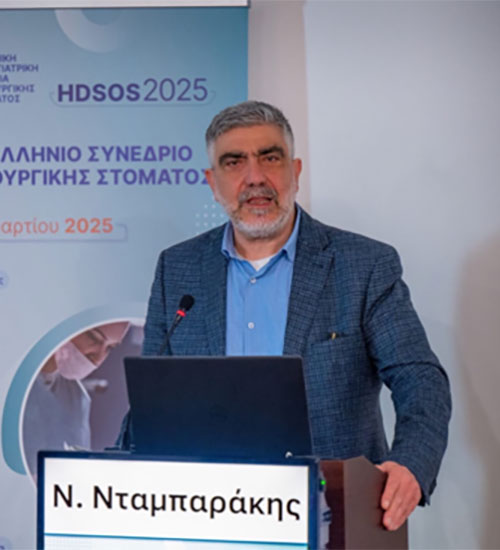
Nikolaos Ntamparakis graduated from the School of Dentistry at the Aristotle University of Thessaloniki (A.U.Th.) in 1988. After military service, he established his dental practice in Thessaloniki, specializing in Oral Surgery.
His long academic career at the Department of Dentistry at A.U.Th. began in 1988, where he served as an unpaid scientific associate. He completed the two-year postgraduate program in "Minor Oral Surgery, Radiology and Anesthesiology" in 1995 and was awarded a Doctorate in 1998. Following his election, he was appointed Lecturer in Dentoalveolar Surgery, Surgical Implantology, and Radiology in 2002, moving through the academic ranks to be elected to Professor in 2024.
Currently, he serves as the Director of the Laboratory of Oral and Maxillofacial Surgery, Surgical Implantology, and Radiology and the Director of the Postgraduate Programme of Oral Surgery at the Dental School of Thessaloniki. He also directs two lifelong learning programs in Implantology and Dental Radiology. Furthermore, he is the President of the Three-Member Examination Committee for the Award of the Specialty Title in Oral Surgery of the Greek Ministry of Health.
He is a prolific contributor to his field, with over 80 publications in national and international scientific magazines, numerous lectures in Oral Surgery and Implantology, and the authorship of three books on Dental Anesthesiology and Surgical Implantology.
Biologically Guided Implant Surgery: Aesthetics and Zero Bone Loss
The contemporary goal in dental implant placement surpasses osseointegration, setting the excellent aesthetics and zero bone loss around the implant as primary objectives.
Essentially, this approach is not limited to prosthetically guided surgery, but adopts a biologically guided surgical philosophy. This philosophy integrates recent advancements in implant characteristics, connection type, prosthetic emergence profile, prosthetic material, and, crucially, the depth of implant platform placement.
This lecture summarizes the key points for successful implant restoration without bone loss, according to the following guidelines:
• Absolute respect for the biology and aesthetics of the peri-implant tissues.
• Implementation of a correct emergence profile with a concave shape (commensurate with the gingival biotype), use of a prosthetic angle of <30°, polished zirconia, and a screw-retained restoration.
• Ensuring sufficient bone around the implant, and paying attention to soft tissue thickness, which influences prognosis and placement depth. Selection of implants with a switch platform and ensuring the smooth part of the implant is above the bone.
• For soft tissue thickness >3mm, equicrestal placement is recommended. In case of subcrestal placement, it should not exceed 2mm, in combination with a conical connection <20°, switch platform, and transmucosal component height equal to the placement depth.
Nikolaos Ntamparakis graduated from the School of Dentistry at the Aristotle University of Thessaloniki (A.U.Th.) in 1988. After military service, he established his dental practice in Thessaloniki, specializing in Oral Surgery.
His long academic career at the Department of Dentistry at A.U.Th. began in 1988, where he served as an unpaid scientific associate. He completed the two-year postgraduate program in "Minor Oral Surgery, Radiology and Anesthesiology" in 1995 and was awarded a Doctorate in 1998. Following his election, he was appointed Lecturer in Dentoalveolar Surgery, Surgical Implantology, and Radiology in 2002, moving through the academic ranks to be elected to Professor in 2024.
Currently, he serves as the Director of the Laboratory of Oral and Maxillofacial Surgery, Surgical Implantology, and Radiology and the Director of the Postgraduate Programme of Oral Surgery at the Dental School of Thessaloniki. He also directs two lifelong learning programs in Implantology and Dental Radiology. Furthermore, he is the President of the Three-Member Examination Committee for the Award of the Specialty Title in Oral Surgery of the Greek Ministry of Health.
He is a prolific contributor to his field, with over 80 publications in national and international scientific magazines, numerous lectures in Oral Surgery and Implantology, and the authorship of three books on Dental Anesthesiology and Surgical Implantology.
This site uses cookies. Find out more about cookies and how you can refuse them.