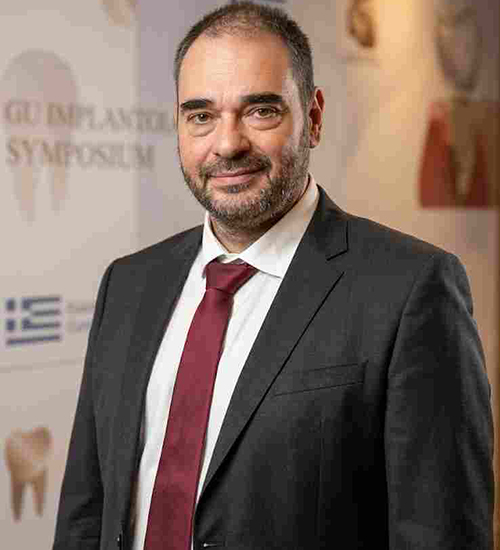
Share This Speaker

Guided autologous bone grafting of atrophic residual alveolar ridge: the SAFECUT concept.
Athanassios Kyrgidis¹,²
¹Oral and Maxillofacial Surgery Clinic, G. Papanikolaou Hospital, Thessaloniki, Greece
²Laboratory of Oral and Maxillofacial Surgery, Aristotle University of Thessaloniki, Greece
Introduction: Severe alveolar ridge atrophy remains a significant challenge in dental implantology, often requiring advanced augmentation prior to prosthetic rehabilitation. While autogenous bone is the "gold standard" for 3D reconstruction, traditional harvesting from the mandibular ramus entails risks of neurovascular injury and technique-sensitive manual osteotomies. Objective: To present the SAFECUT technique, a computer-guided approach for harvesting autogenous bone blocks designed to enhance surgical precision and patient safety. Materials and Methods: The protocol utilizes a dedicated plugin within the RealGUIDE software to plan three-dimensional cutting planes based on Cone-Beam CT data. This digital workflow produces a 3D-printed surgical guide (SAFECUT guide) that outlines the harvest socket, ensuring predictable outcomes. The harvested block is processed via the Khoury "Split-Bone" philosophy, where the block is divided into thin cortical plates and stabilized with osteosynthesis screws to create a biological container filled with autogenous bone chips. Results: Clinical application demonstrates that digital planning significantly improves technical efficiency by reducing operative time and minimizing stress for both surgeon and patient. The guided harvest ensures precise dimensions, maximizing the available bone while protecting vital structures like the inferior alveolar nerve. Presented cases show excellent initial graft stability and high predictability in volume gain. Conclusions: The SAFECUT technique revolutionizes autogenous bone harvesting by integrating digital precision into traditional regenerative methods. This approach offers a reproducible, safe, and efficient pathway for managing complex bone deficits in the atrophic jaw.
Dr. Athanasios Kyrgidis, MD, DDS, MSc, PhD, ScD
Dr. Athanasios Kyrgidis serves as Consultant Oral and Maxillofacial Surgeon at the G. Papanikolaou General Hospital in Thessaloniki, Greece, having achieved the top ranking in three consecutive clinical appointments. His clinical expertise encompasses the full spectrum of head and neck oncological and reconstructive surgery, with a specialized focus on skin cancer.
He has pioneered the implementation of complex surgical procedures, including:
• Reconstructive Flaps: Performance of supraclavicular and facial artery axial flaps.
• Specialized Oncology: Mohs micrographic surgery for facial epitheliomas.
• Melanoma Care: Sentinel lymph node biopsy for head and neck melanoma.
Academic and Research Contributions
Dr. Kyrgidis possesses extensive academic experience, including 16 years of teaching in undergraduate and postgraduate programs. For the past 6 years, he has served as a lead instructor at the Aristotle University of Thessaloniki (AUTh) Center for Education and Lifelong Learning, specifically for the program: "Reconstruction of the Deficient Alveolar Ridge – Preprosthetic Surgery – Advanced Dental Implantology Re-Pro-Implant".
His research impact is internationally recognized:
• Bone Metabolism: Significant contributions with 42 specialized publications in this field.
• Publication Record: A total of 194 peer-reviewed publications.
• Academic Metrics: A cumulative Impact Factor exceeding 2,075 and an h-index of 45.
• Global Recognition: He is honored to be among the 244 AUTh faculty members included in the Stanford University Top 2% Scientists List for 2025.
Editorial and Leadership Roles
Dr. Kyrgidis holds several high-level leadership positions within the scientific community:
• Editor-in-Chief: Archives of Hellenic Oral & Maxillofacial Surgery.
• Editor-in-Chief: Clinics and Practice (MDPI).
• Executive Board Member: Hellenic Association for Oral and Maxillofacial Surgery (HAOMS).
Guided autologous bone grafting of atrophic residual alveolar ridge: the SAFECUT concept.
Athanassios Kyrgidis¹,²
¹Oral and Maxillofacial Surgery Clinic, G. Papanikolaou Hospital, Thessaloniki, Greece
²Laboratory of Oral and Maxillofacial Surgery, Aristotle University of Thessaloniki, Greece
Introduction: Severe alveolar ridge atrophy remains a significant challenge in dental implantology, often requiring advanced augmentation prior to prosthetic rehabilitation. While autogenous bone is the "gold standard" for 3D reconstruction, traditional harvesting from the mandibular ramus entails risks of neurovascular injury and technique-sensitive manual osteotomies. Objective: To present the SAFECUT technique, a computer-guided approach for harvesting autogenous bone blocks designed to enhance surgical precision and patient safety. Materials and Methods: The protocol utilizes a dedicated plugin within the RealGUIDE software to plan three-dimensional cutting planes based on Cone-Beam CT data. This digital workflow produces a 3D-printed surgical guide (SAFECUT guide) that outlines the harvest socket, ensuring predictable outcomes. The harvested block is processed via the Khoury "Split-Bone" philosophy, where the block is divided into thin cortical plates and stabilized with osteosynthesis screws to create a biological container filled with autogenous bone chips. Results: Clinical application demonstrates that digital planning significantly improves technical efficiency by reducing operative time and minimizing stress for both surgeon and patient. The guided harvest ensures precise dimensions, maximizing the available bone while protecting vital structures like the inferior alveolar nerve. Presented cases show excellent initial graft stability and high predictability in volume gain. Conclusions: The SAFECUT technique revolutionizes autogenous bone harvesting by integrating digital precision into traditional regenerative methods. This approach offers a reproducible, safe, and efficient pathway for managing complex bone deficits in the atrophic jaw.
Dr. Athanasios Kyrgidis, MD, DDS, MSc, PhD, ScD
Dr. Athanasios Kyrgidis serves as Consultant Oral and Maxillofacial Surgeon at the G. Papanikolaou General Hospital in Thessaloniki, Greece, having achieved the top ranking in three consecutive clinical appointments. His clinical expertise encompasses the full spectrum of head and neck oncological and reconstructive surgery, with a specialized focus on skin cancer.
He has pioneered the implementation of complex surgical procedures, including:
• Reconstructive Flaps: Performance of supraclavicular and facial artery axial flaps.
• Specialized Oncology: Mohs micrographic surgery for facial epitheliomas.
• Melanoma Care: Sentinel lymph node biopsy for head and neck melanoma.
Academic and Research Contributions
Dr. Kyrgidis possesses extensive academic experience, including 16 years of teaching in undergraduate and postgraduate programs. For the past 6 years, he has served as a lead instructor at the Aristotle University of Thessaloniki (AUTh) Center for Education and Lifelong Learning, specifically for the program: "Reconstruction of the Deficient Alveolar Ridge – Preprosthetic Surgery – Advanced Dental Implantology Re-Pro-Implant".
His research impact is internationally recognized:
• Bone Metabolism: Significant contributions with 42 specialized publications in this field.
• Publication Record: A total of 194 peer-reviewed publications.
• Academic Metrics: A cumulative Impact Factor exceeding 2,075 and an h-index of 45.
• Global Recognition: He is honored to be among the 244 AUTh faculty members included in the Stanford University Top 2% Scientists List for 2025.
Editorial and Leadership Roles
Dr. Kyrgidis holds several high-level leadership positions within the scientific community:
• Editor-in-Chief: Archives of Hellenic Oral & Maxillofacial Surgery.
• Editor-in-Chief: Clinics and Practice (MDPI).
• Executive Board Member: Hellenic Association for Oral and Maxillofacial Surgery (HAOMS).
This site uses cookies. Find out more about cookies and how you can refuse them.