Share This Speaker

The effect of occlusal disorders on root canal treatment procedures
Several aspects of temporomandibular disorders, including occlusal parafunction, mal-occlusion, bruxism and clenching may affect decision-making and treatment outcomes in single teeth that require root canal treatment. Occlusal disorders may have an impact on pulp biology, resulting in calcific metamorphosis, pulp necrosis or apical periodontitis. In addition, occlusal stress and trauma may affect tooth structure, resulting in crack propagation and vertical root fracture. Finally, an increasing percentage of teeth are affected by external cervical root resorption. The aim of this lecture is to provided up-to-date insights in a relatively unforeseen clinical issue that potentially affects endodontic diagnosis and treatment planning.
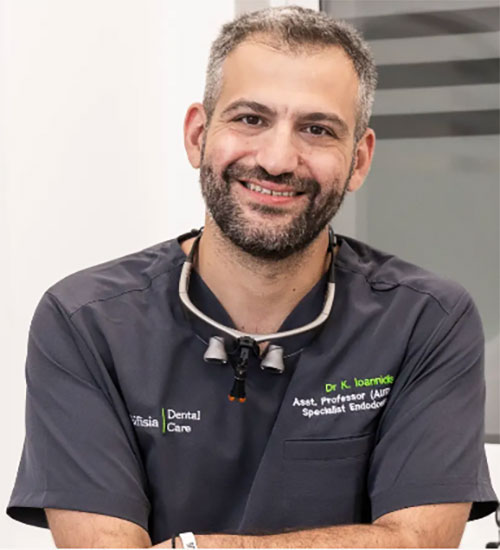
Konstantinos Ioannidis
DDS, MSc, PhD, DipFMS, DipFHId
Specialist Endodontist
PhD in Endodontology and Dental Materials (King’s College London, Dental Institute, UK)
Assistant Professor in Endodontology, Aristotle University of Thessaloniki, Greece.
Academic Foundation: He graduated from the Aristotle University of Thessaloniki (AUTH) School of Dentistry in 2007, subsequently completing a three-year postgraduate residency program in Endodontology at AUTH in 2010.
International Career: Between 2011 and 2023, he lived and practiced in London, UK. He is a registered Specialist in Endodontics with the British General Dental Council (GDC No. 207658).
Advanced Research: In 2019, he earned his PhD from King’s College London (Guy’s Hospital). His research focused on the formation of toxic disinfection by-products during root canal preparation.
Forensic Expertise: During 2021–2022, he expanded his expertise through the Academy of Forensic Medical Sciences, obtaining a Diploma in Forensic Medical Sciences and a Diploma in Forensic Human Identification.
Current Position: Since 2023, he has served as an Assistant Professor of Endodontology at Aristotle University of Thessaloniki.
The effect of occlusal disorders on root canal treatment procedures
Several aspects of temporomandibular disorders, including occlusal parafunction, mal-occlusion, bruxism and clenching may affect decision-making and treatment outcomes in single teeth that require root canal treatment. Occlusal disorders may have an impact on pulp biology, resulting in calcific metamorphosis, pulp necrosis or apical periodontitis. In addition, occlusal stress and trauma may affect tooth structure, resulting in crack propagation and vertical root fracture. Finally, an increasing percentage of teeth are affected by external cervical root resorption. The aim of this lecture is to provided up-to-date insights in a relatively unforeseen clinical issue that potentially affects endodontic diagnosis and treatment planning.
Konstantinos Ioannidis
DDS, MSc, PhD, DipFMS, DipFHId
Specialist Endodontist
PhD in Endodontology and Dental Materials (King’s College London, Dental Institute, UK)
Assistant Professor in Endodontology, Aristotle University of Thessaloniki, Greece.
Academic Foundation: He graduated from the Aristotle University of Thessaloniki (AUTH) School of Dentistry in 2007, subsequently completing a three-year postgraduate residency program in Endodontology at AUTH in 2010.
International Career: Between 2011 and 2023, he lived and practiced in London, UK. He is a registered Specialist in Endodontics with the British General Dental Council (GDC No. 207658).
Advanced Research: In 2019, he earned his PhD from King’s College London (Guy’s Hospital). His research focused on the formation of toxic disinfection by-products during root canal preparation.
Forensic Expertise: During 2021–2022, he expanded his expertise through the Academy of Forensic Medical Sciences, obtaining a Diploma in Forensic Medical Sciences and a Diploma in Forensic Human Identification.
Current Position: Since 2023, he has served as an Assistant Professor of Endodontology at Aristotle University of Thessaloniki.
This site uses cookies. Find out more about cookies and how you can refuse them.