Share This Speaker

Clinical Approaches for Calcified Canal Treatment.
The success of root canal therapy hinges on the utilisation of appropriate access cavity, cleaning, shaping, and root filling techniques. Pulp canal calcification arises from the deposition of calcified tissue in the canal walls due to trauma and other factors. Consequently, the root canal space can be partially or completely occluded. In this context, endodontic treatments of severely calcified teeth are regarded as exceptionally challenging and intricate.
For several years, clinicians have endeavoured to resolve these intricate treatments employing “freehand” techniques. However, these techniques encounter significant challenges in canal localization and treatment, potentially resulting in damage to the tooth’s initial anatomy. Consequently, the freehand technique has been restricted to the expertise of a select few experienced clinicians.
Presently, with the advancement of digital enhancements in endodontic therapy, guided navigation of the root canal (both static and dynamic) has become an integral component of the daily clinical approach to this challenging and unpredictable procedure. This approach offers a safer methodology and more predictable outcomes, irrespective of the clinician’s level of experience.
Conversely, these techniques for success are time-consuming, the overall cost of the therapy increases substantially, and necessitate meticulous planning by experienced clinicians.
The most pertinent question arises regarding the most effective treatment approach for calcified canals and the optimal technique to employ in each case.
The primary objective of this lecture is to compare the two techniques and emphasise the significance of each approach. Additionally, it will present a method for effectively managing obliterated canals.
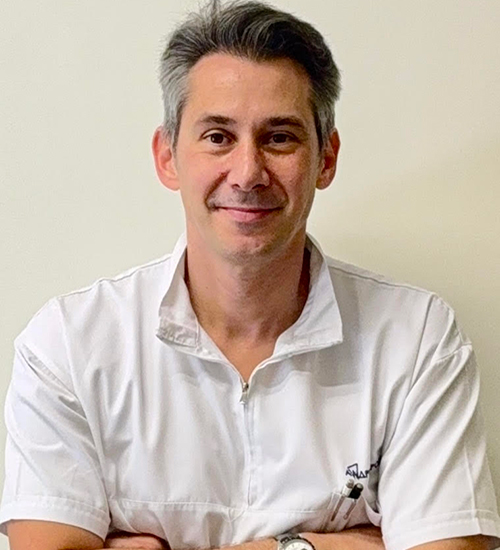
Prof. Andreas Krokidis DDS MSc PhD
Dr Andreas Krokidis (DDS, MSc, Phd) was born in Corfu (Greece) in 1982 and graduated from Dental school of the University of Brescia (Italy) in 2004.
In 2008 he carried out his Masters in Endodontics from the University of Verona (Italy).
In 2019 he presented his Phd thesis in endodontics in the University of Athens (Greece).
He is currently an Ass. Professor in Endodontics at the National an Kapodistrian University of Athens (NKUA) (Greece).
He is a certified member of the European society of Endodontics (ESE) since 2011, International member of the Americal Association of Endodontics (AAE), certified member of the Hellenic Endodontic Society (EEE), and he is also founder and the secretary of the Hellenic Academy of Clinical Dentistry (www.akod.gr).
He has won the “Premio Garberoglio” prize of the Italia Society of Endodontics (SIE) in 2008 for the best research presented.
His scientific work includes publication in international and national journals, books and clinical guides in the field of endodontics and restorative dentistry, continuous presence in national and international congresses as a speaker. He also provides private courses in endodontics in his fully equipped course center in Athens (Greece).
Clinical Approaches for Calcified Canal Treatment.
The success of root canal therapy hinges on the utilisation of appropriate access cavity, cleaning, shaping, and root filling techniques. Pulp canal calcification arises from the deposition of calcified tissue in the canal walls due to trauma and other factors. Consequently, the root canal space can be partially or completely occluded. In this context, endodontic treatments of severely calcified teeth are regarded as exceptionally challenging and intricate.
For several years, clinicians have endeavoured to resolve these intricate treatments employing “freehand” techniques. However, these techniques encounter significant challenges in canal localization and treatment, potentially resulting in damage to the tooth’s initial anatomy. Consequently, the freehand technique has been restricted to the expertise of a select few experienced clinicians.
Presently, with the advancement of digital enhancements in endodontic therapy, guided navigation of the root canal (both static and dynamic) has become an integral component of the daily clinical approach to this challenging and unpredictable procedure. This approach offers a safer methodology and more predictable outcomes, irrespective of the clinician’s level of experience.
Conversely, these techniques for success are time-consuming, the overall cost of the therapy increases substantially, and necessitate meticulous planning by experienced clinicians.
The most pertinent question arises regarding the most effective treatment approach for calcified canals and the optimal technique to employ in each case.
The primary objective of this lecture is to compare the two techniques and emphasise the significance of each approach. Additionally, it will present a method for effectively managing obliterated canals.
Prof. Andreas Krokidis DDS MSc PhD
Dr Andreas Krokidis (DDS, MSc, Phd) was born in Corfu (Greece) in 1982 and graduated from Dental school of the University of Brescia (Italy) in 2004.
In 2008 he carried out his Masters in Endodontics from the University of Verona (Italy).
In 2019 he presented his Phd thesis in endodontics in the University of Athens (Greece).
He is currently an Ass. Professor in Endodontics at the National an Kapodistrian University of Athens (NKUA) (Greece).
He is a certified member of the European society of Endodontics (ESE) since 2011, International member of the Americal Association of Endodontics (AAE), certified member of the Hellenic Endodontic Society (EEE), and he is also founder and the secretary of the Hellenic Academy of Clinical Dentistry (www.akod.gr).
He has won the “Premio Garberoglio” prize of the Italia Society of Endodontics (SIE) in 2008 for the best research presented.
His scientific work includes publication in international and national journals, books and clinical guides in the field of endodontics and restorative dentistry, continuous presence in national and international congresses as a speaker. He also provides private courses in endodontics in his fully equipped course center in Athens (Greece).
This site uses cookies. Find out more about cookies and how you can refuse them.